
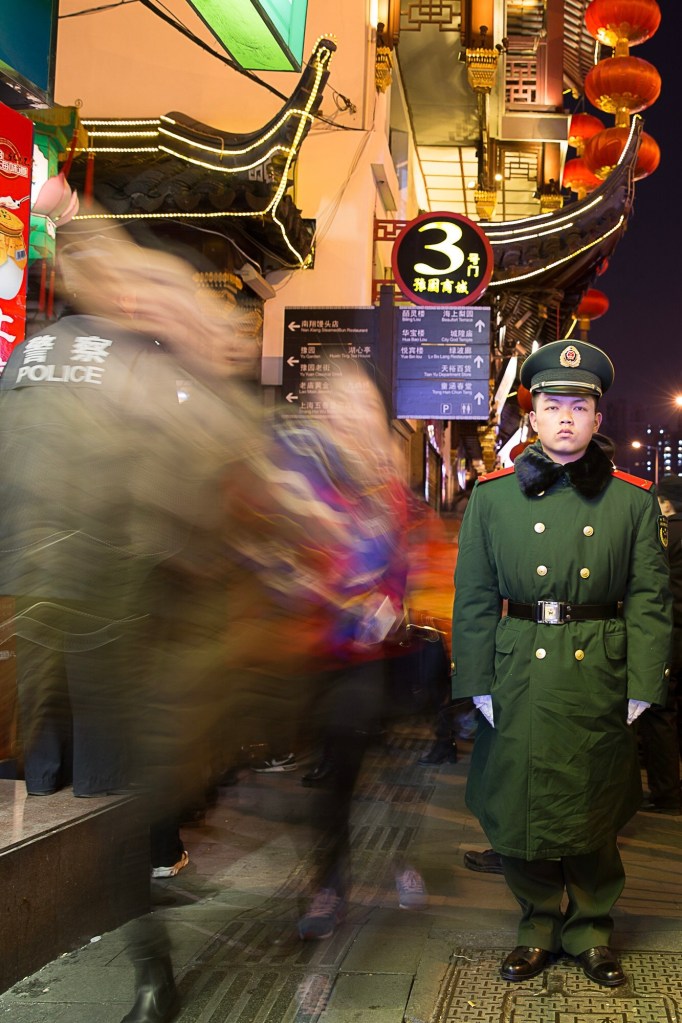
This image was taken during one of my evenings in China, and it has stayed with me since the moment I pressed the shutter. The young policeman stood perfectly still while the world around him blurred into a rush of motion and noise. He didn’t flinch, didn’t turn his head, didn’t blink. He became like a statue amidst a flood of passing ghosts.
I remember wondering then—what kind of training does it take to stand so unmoved by the world? What sort of internal switch allows someone to separate themselves from their surroundings so completely? You see this often in places where discipline is demanded, where silence is taught, and where control is expected—like China.
I lived in China for twelve years, and those years continue to echo in my memory like faint melodies in a large hall. Some memories are sharp, like the sound of metal against concrete. Others are soft, like silk fluttering in a quiet room. But they never truly leave. They reappear unexpectedly—in a certain color of neon light, in the smell of a certain spice, or in the echo of boots on a wet sidewalk.
There’s a rhythm to a place like China. A pulse you either learn to live with or leave. I chose to stay—for over a decade—and during that time, I learned to observe in silence, to feel what wasn’t spoken, and to move through life like a visitor always half inside and half out.
Some memories fade into oblivion, forgotten until a photo, a sound, or a word pulls them from the depths. Others stay on the surface, haunting, vivid, unwilling to dissolve.
This image reminds me that in every fast-moving world, there are those who are trained to remain still. And maybe that’s the metaphor that sticks with me the most. Stillness is its own kind of power.
3 responses to “Stillness in the Rush~”
Some people have zero visual memory. I can still remember visuals from when I was 3. I’m sure your art helps you remember more…
Great shot. Again.
You are lucky to remember .
Can’t complain… LOL